Report Summary
Period covered 02 August – 29 August 2026
3 minute read
Note: This report summary is one or two months behind the current month as standard reporting practice. The content is indicative only and incomplete with certain data undisclosed. Become a member to access this data or take out a free 30 day membership trial now.
Electricals sales
Electricals sales increased by xx% year-on-year in August, broadly in line with the xx% rise recorded in July and ahead of the xx% growth seen in August last year.
Across the summer, the strongest growth was concentrated in May and June before sales settled at a slower rate during July and August.
Key drivers and category performance
With temperatures reaching 38.1°C at Kew Gardens during another mid-August heatwave, cooling-related electricals had a further opportunity to benefit from exceptionally hot weather.
August was very different from the beginning of the summer, however, because similar conditions had been present since May and many consumers who needed fans or other cooling products had already had several opportunities to buy them.
As the August heatwave passed, back-to-school became more prominent towards the end of the month and provided a different purchasing occasion ahead of September. Yet electricals finished the month only slightly ahead of July, suggesting that the change in seasonal spending was not large enough to materially alter the category's overall performance.
The financial position facing households became less favourable as inflation rose to xx% in August, regular wage growth slowed to xx%, and mortgage costs remained high. Another increase in energy bills is due in October, creating further competition for household budgets as electricals move away from the unusual weather-related demand of the summer and towards the important final months of the year.
Digital channels remain an important part of electricals retailing, and the wider online market recorded strong growth during August. Online Household Goods sales, which includes items such as electrical appliances and audio and visual equipment surged xx% YoY in August, its strongest rise in almost three years.
Macroeconomic backdrop
With CPI inflation increasing to xx% in August from xx% in July andxx% in June, the improvement in household purchasing power became smaller as the summer progressed. Regular wage growth slowed to xx%, leaving earnings only slightly ahead of inflation at a time when consumers were also facing higher costs across several areas of essential expenditure.
Household energy costs were already xx% higher than a year earlier in August, and Ofgem has confirmed a further 4% increase in the price cap from October, taking the typical dual-fuel annual bill to £xx.
With the Bank of England holding Bank Rate at xx% in September, borrowing costs also remain elevated for households with mortgages and other forms of credit. The effective interest rate on newly drawn mortgages increased to 4.45% in July, its highest level this year, adding to the financial pressures facing households refinancing or purchasing a property.
But housing activity remained muted, with mortgage approvals falling to 56,100 in July, around 15% below a year earlier and their lowest level since January 2024. Lower levels of housing activity reduces the opportunity for households to replace or add products.
Further pressure came from the labour market, where payrolled employment was estimated to have fallen by xx in August and 145,000 over the year, while vacancies declined to xx their lowest level since 2021. Regular wage growth of 3.5% remained ahead of inflation, but by a much narrower margin than earlier in the year.
One bright spot was consumer confidence, which improved to xx in August, its highest level in two years, with attitudes towards major purchases also strengthening. This leaves a notable difference between the improvement in sentiment and the pace of spending within the category.
Take out a FREE 30 day membership trial to read the full report.
Consumer confidence improved
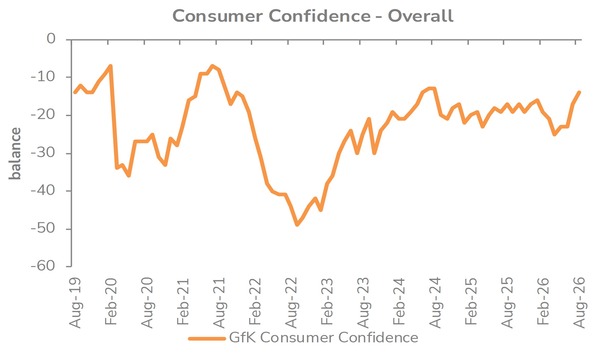 Source: Retail Economics, ONS