Report Summary
Period covered 02 August – 29 August 2026
3 minute read
Note: This report summary is one or two months behind the current month as standard reporting practice. The content is indicative only and incomplete with certain data undisclosed. Become a member to access this data or take out a free 30-day membership trial now.
Retail Sales Performance:
August 2026 UK retail sales remained positive, although growth slowed, while support from weather, sporting events and promotions changed through the month.
Retail sales rose xx% year-on-year according to the Retail Economics Retail Sales Index, easing from xx% in the previous month.
Factors impacting the headline performance in the month include:
Back-to-school: Back-to-school demand became more prominent during the second half of August as temperatures eased. This provided a boost to spending across clothing, footwear, stationery and selected electricals, partly replacing the sporting occasions that supported June and July.
Fewer events: The World Cup and Wimbledon had ended, leaving August with fewer major spending occasions. The late August bank holiday offered some support, but much of it fell at the end of the retail reporting period.
Consumer confidence: The index rose 3 points to xx, while the Major Purchase Index rose 5 points to -7. Stronger sentiment had yet to translate into materially higher discretionary spending.
Category impact
Performance remained positive across most retail categories in August, although the pace of growth continued to vary considerably by sector. The strongest stories reflected a combination of current performance, month-on-month change and divergence between related categories.
Health & beauty remained the strongest-performing category, increasing xx% year-on-year and slowing from xx% previously. Seasonal personal care and sun protection added support, while affordable discretionary purchases remained resilient.
Clothing rose xx%, slowing from xx% previously, while footwear fell xx% versus xx% previously. Earlier warm-weather purchases reduced the incremental seasonal benefit and widened the gap within fashion.
Food and grocery sales rose xx%, slowing from xx% previously. Hot weather and sporting occasions supported outdoor eating and summer socialising, while easing inflation supported budgets but kept value growth relatively restrained.
Outlook: Better than feared, but far from comfortable
The UK economy has held up better than expected this year. Growth has been stronger than feared, retail volumes are still rising, and households entered the second half of 2026 in a better financial position than many expected at the start of the year.
But the next few months look more difficult. Inflation is climbing again, borrowing costs are unlikely to fall quickly and higher energy and input costs are working their way back through the supply chain. The challenge for retailers is increasingly whether demand can hold up as household finances come under renewed pressure at the same time as costs begin to rise.
Take out a FREE 30 day membership trial to read the full report.
Confidence edges up
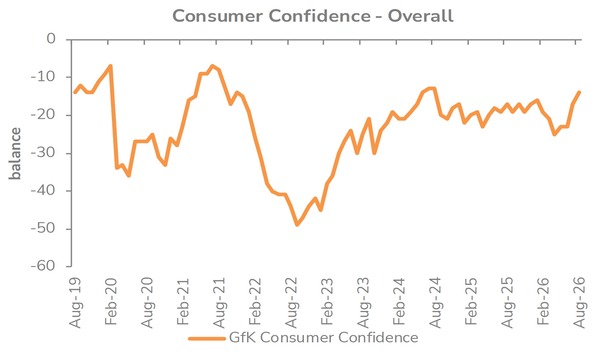 Source: Retail Economics, GFK